

10 Things I’m Doing to Start the New Year Strong

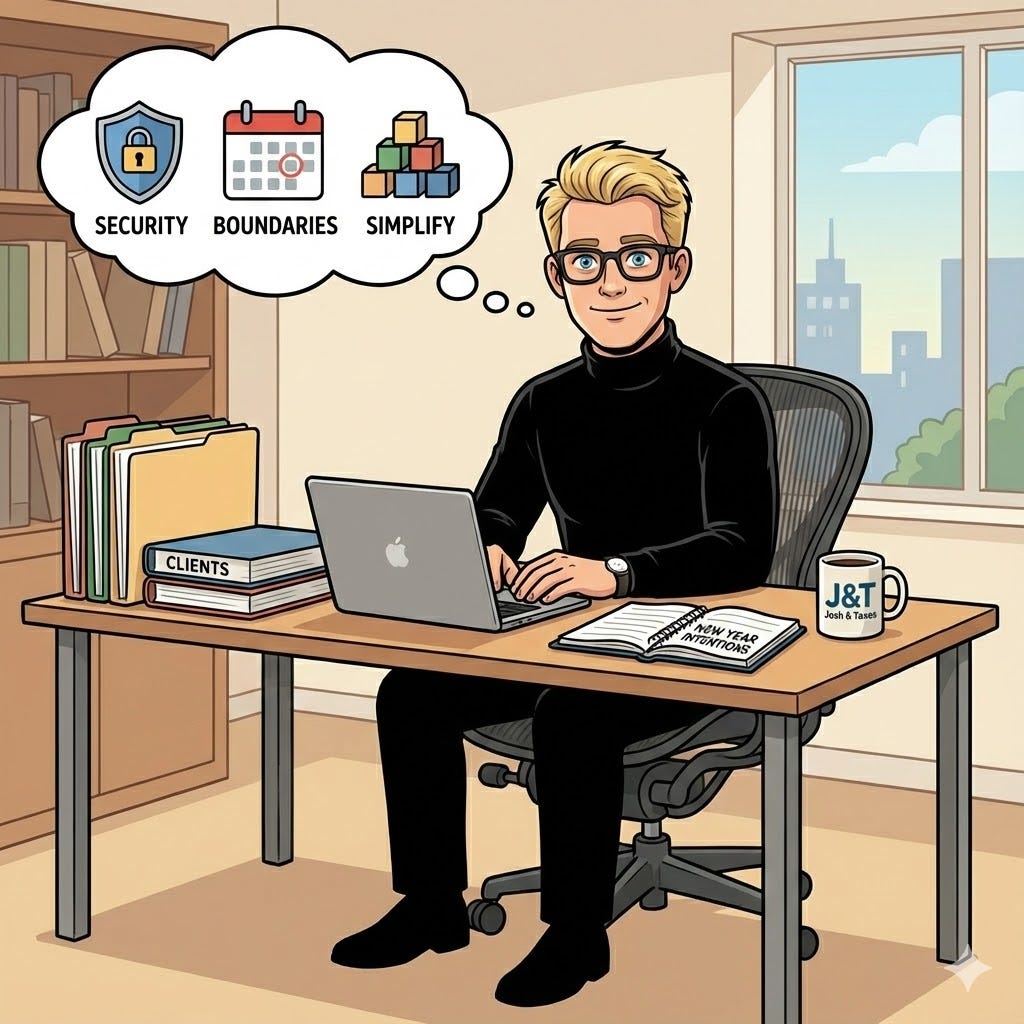
The end of the year always feels a little strange for tax professionals. While everyone else is slowing down, we’re usually gearing up for what’s commonly framed as “tax season.”
I don’t see tax season as some looming beast to survive. It’s busier, yes, but it’s just one part of a year-round practice I’ve intentionally built. By spreading work throughout the year and focusing on representation, teaching, and technology, the spring rush becomes manageable instead of overwhelming.
Instead of vague resolutions, I’m being deliberate. These are the 10 things I’m doing as we head into the new year to protect my energy, my practice, and my sanity.
If even one of these helps you, it’s worth it. I’d love to hear what you are doing, so please comment.
1. Closing Loops, Not Opening New Ones
I’m resisting the urge to start new projects simply because it’s January. Instead, I’m closing open loops. Unfinished drafts, half-built systems, lingering client matters. Clean endings create mental space, and mental space is a competitive advantage. I have reviewed my calendar, set parameters for when I will take calls, and created a structure for which days I work on what. For example, tax practice days are on Mondays, and Tuesdays are for writing and education. If you have multiple areas of your business, it can be helpful to assign certain days to specific tasks.
2. Auditing My Client List
Not all revenue is good revenue. I’m reviewing which clients respect advice, communicate clearly, and value the work. I’m also honest about which relationships consistently create friction. Fewer fires make room for better service. If someone is exhausting to interact with, that’s your sign to make a change.
3. Reviewing Subscriptions and Recurring Expenses
Every year, I find tools and services I forgot I was paying for. I’m auditing subscriptions across software, education platforms, and “nice-to-have” tools. If it didn’t meaningfully support my work this year, it doesn’t come with me into the next one.
Less clutter, fewer decisions, lower overhead.
One thing I do is to sign up for services using a virtual credit card number. Most card companies support this, it forces you to be more intentional when it comes time for renewal.
4. Setting Communication Boundaries Early
I’m clearly communicating response times, availability, and escalation paths before things get busy. Setting expectations now reduces urgency later.
Boundaries are the single best thing you can do for yourself. It took me many years to understand that.
5. Simplifying My Tech Stack
Every tool promises efficiency. Too many tools create friction. I’m trimming anything that adds complexity without real payoff and doubling down on systems that actually support how I work.
Simple systems are easier to maintain under pressure.
Please do not think that AI is going to solve all of your problems or that automation will take the place of a full time employee. While both are great tools, it is important to keep things in perspective.
6. Planning Travel Intentionally
I’m looking at the year ahead and planning travel early, both personal and professional. Knowing when I’ll be out, slower, or fully unplugged helps me set realistic expectations for myself and my clients.
Downtime doesn’t happen accidentally. It has to be planned. This last vacation, I unplugged more than I have in years, and it was nice. I plan to repeat it.
7. Reviewing Security and Privacy Practices
This is always a good time to review your WISP (Written Information Security Plan) and internal practices. Our clients put a lot of trust in us with their data. Not to mention our legal obligations. If you’re interested in learning more about WISPs and how to implement one, consider joining me on Monday, December 29th, for a 4-hour workshop. I promise it will not be boring.
8. Re-Reading My Own Engagement Terms
I’m reviewing my own agreements and policies as if I were the client. If something is unclear, buried, or unrealistic, I’m fixing it now instead of arguing about it later.
Clarity upfront saves stress when things get busy. It is important to remember that an engagement letter should be concise rather than voluminous. We all know that clients do not often read everything.
I find that no more than 4 pages is best.
9. Protecting My Energy Like It’s a Business Asset
Because it is. I’m being realistic about sleep, recovery time, and burnout triggers. A depleted professional doesn’t serve clients well. Wasting energy on things that do not matter is also a no-go. There is no shortage of drama and chaos in the world, and if you aren’t mindful of that, you can get pulled into it.
Social media can drain your energy. It is important to have limits.
10. Remembering This Is a Marathon
Tax season will end. It always does. But it doesn’t define the entire year. A practice built around representation, education, and technology doesn’t need fear to function.
The goal isn’t to survive a season. It’s to build work that still feels sustainable when it’s over. It’s about building a practice you actually enjoy working in and on.
As we head into the new year, I’m reminding myself that preparation isn’t just about checklists and deadlines. It’s about clarity, boundaries, and choosing what actually matters.
Here’s to a steady start and a sane year ahead.
Happy holidays,
Josh 🎄✨